Fears are growing that the coronavirus outbreak could reach pandemic scale as more cases emerge around the world.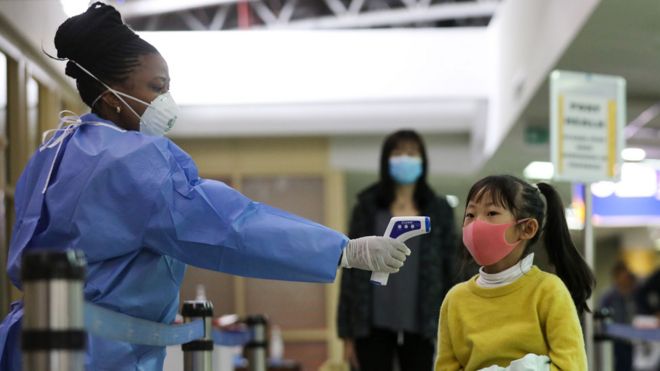
Top stories

Spike in South
Korea, and Fear
Builds

Venice Carnival
closes as Italy
imposes lockdown

Raises Threat Alert
Level
Most infections are in China but other nations like South Korea, Italy and Iran are battling the virus, which causes respiratory disease Covid-19.
A pandemic is when an infectious disease spreads easily from person to person in many parts of the world.
About 77,000 people in China, where the virus emerged last year, have been infected and nearly 2,600 have died.
More than 1,200 cases have been confirmed in about 30 other countries and there have been more than 20 deaths. Italy reported two more deaths on Monday, raising the total there to five.
Coronavirus: Are African countries ready?
Egypt has confirmed its first case of the new coronavirus – heralding its entry into Africa, a continent with increasingly close ties to China where the virus originated.
The World Health Organization (WHO) has already declared the coronavirus outbreak a global health emergency – largely because of fears that poorer countries may not be able to cope with an outbreak.
“The main reason for this declaration is not what is happening in China but what is happening in other countries. Our greatest concern is the potential for the virus to spread to countries with weaker health systems,” said WHO chief Tedros Adhanom Ghebreyesus, who is from Ethiopia.
The health systems in many African countries are already struggling with the existing workload, so can they deal with another outbreak of a highly infectious disease?
Michael Yao, WHO’s head of emergency operations in Africa, notes that some countries on the continent “have the minimum to start with – they’re not starting from scratch”.
“We know how fragile the health system is on the African continent and these systems are already overwhelmed by many ongoing disease outbreaks, so for us it is critical to detect earlier so that we can prevent the spread.”
What facilities are there at the moment to treat it?
Until early this week, there were only two laboratories in Africa – one in Senegal and the other in South Africa – which had the reagents needed to test samples. They have been working as referral laboratories for countries around the region.
One of the laboratories, Institut Pasteur de Dakar, in Senegal has long been on the front line in medical innovation in Africa, including in yellow fever research.
However this week Ghana, Madagascar, Nigeria and Sierra Leone have announced they can also conduct tests.
The WHO is also sending kits to 29 laboratories on the continent to ensure they have the capacity to deal with the virus and also help test samples from other countries if needed.
However it’s hoped that by later this month at least 36 African countries will be equipped to carry out tests specific to the coronavirus.
The ability of African nations to properly diagnose cases “depends on the new reagents being made available from China and Europe,” says Dr Yao.
The Nigerian Red Cross Society says it has placed one million volunteers on alert. Its Secretary General Abubakar Ahmed Kende said the measure was to prevent the possible spread of the virus into the country and also contain the spiralling outbreak of Lassa fever across the country.
In Tanzania, Health Minister Ummy Mwalimu announced that isolation centres in the north, east and west of the country had been identified. Thermometers have been stockpiled and more than 2,000 health workers have been trained.
Several countries including Kenya, Ethiopia, Ivory Coast, Ghana and Botswana have dealt with suspected cases, placing them in quarantine while tests were carried out. So far, all have tested negative for the virus.
Uganda’s health ministry confirmed it had quarantined more than 100 people who have arrived at Entebbe International Airport. Some of the people have been quarantined at two hospitals in Entebbe and Kampala, while others have been asked to stay in their homes.
Have any lessons been learned from Ebola?
Dr Yao was involved in dealing with the outbreaks of Ebola in West Africa in 2014-2016 and more recently in the east of the Democratic Republic of Congo. He said he was concerned that there was not enough capacity to treat critical cases of coronavirus.
“We’re advising countries to at least detect cases early to avoid spreading the new virus within the community – that will be difficult to manage,” he says.
On a positive note, many African countries were already screening passengers arriving at their ports of entry for Ebola. Countries that dealt with the Ebola outbreak still have the isolation facilities and expertise in controlling infectious diseases.
But when it comes to detection, Ebola is different to the coronavirus. Ebola only became infectious when symptoms showed however there have been reports that in some cases, the coronavirus may have been transmitted before patients were showing symptoms.
The proportion of infected patients dying from Covid-19 appears to be between 1% and 2%, although the World Health Organization (WHO) cautions that the mortality rate is not known yet.
On Monday Iraq, Afghanistan, Kuwait and Bahrain reported their first cases, all involving people who had come from Iran.
WHO chief Tedros Adhanom Ghebreyesus had warned that the window of opportunity to contain the virus was “narrowing”.
Paul Hunter, professor of health protection at the University of East Anglia in the UK, echoed his fears, saying the spike in cases outside China was “extremely concerning”.
“The tipping point after which our ability to prevent a global pandemic seems a lot closer after the past 24 hours,” he said on Monday.